Hall Effect and TMR sticks fix stick drift the same way. They replace the rubbing wiper inside a stock DualSense or DualShock 4 stick with a magnet and a sensor that never touch, so the sensor has no track to wear out. The difference is inside the sensor chip. A TMR sensor gets a much stronger signal from the same magnet, which iFixit says means tighter dead zones and lower jitter. It also draws less current, though the battery gain is modest. Neither type is drift-proof, and on a DualSense or DualShock 4 both have to be calibrated once fitted.
Hall Effect and TMR sticks both read a magnet without touching it, so the sensor has no track to wear. A TMR sensor gives a stronger signal than a Hall sensor; iFixit credits it with tighter dead zones, lower jitter and less noise, and with handling stray magnetic fields much better. The battery gain from TMR is real but modest. Neither sensor wears, but neither stick is drift-proof: iFixit names springs, plastic and dirt as causes that remain on a TMR stick, and calls Hall sticks far less prone to drift, not immune. A new stick in a DualSense or DualShock 4 must be calibrated after fitting, because the stick calibration lives on the controller board, not in the stick.
Why stock DualSense and DualShock 4 sticks drift
Stock sticks drift because their sensor wears out with use. Each DualSense stick has two potentiometers, one per axis, and in each one a wiper runs over a printed carbon track. iFixit says the DualShock 4 uses the same joystick hardware. Every movement takes a little material off the track. Once the resistance at the centre position changes, the controller reads input while your thumb is off the stick.
Tired springs, stretched plastic and dust add to it; the full list of causes, with the free fixes worth trying first, is in the drift guide linked above. The point here is narrower. According to iFixit's explainer on TMR, Sony, Microsoft and Nintendo ship neither Hall Effect nor TMR sticks. Magnetic sticks come only in third-party controllers and aftermarket parts.
How Hall Effect and TMR sticks work
Both use the same layout: a small magnet on the stick shaft and a sensor chip on the board below it. Tilt the stick, the magnet moves, and the sensor reads the change in the magnetic field. Nothing rubs against the sensor. What differs is the physics inside the chip.
Hall Effect
In a Hall Effect stick the wiper is replaced by a magnet, and the carbon track by a Hall element — a flat conductor that responds to magnetic fields. With no contact there is no friction wear on the sensor. The idea isn't new: iFixit points out that the Dreamcast controller used Hall sensors back in 1999.
TMR (tunnel magnetoresistance)
TMR stands for tunnel magnetoresistance. The sensor holds two magnetic layers with an insulating layer between them only a few nanometres thick. Electrons tunnel through that layer, and how easily they do depends on which way the magnet's field points; the sensor reads that as a change in resistance. Sensor maker Allegro sets out the principle in its application note on moving from Hall to TMR.
Hall Effect vs TMR: signal, precision and dead zone
TMR's real advantage is signal strength. A Hall sensor's raw output is tiny — microvolts — and has to be amplified, which costs power, adds noise and is sensitive to temperature. A TMR sensor reading the same magnet produces a significantly stronger signal. In a stick, iFixit says that gives a cleaner, more stable reading: tighter dead zones, lower jitter and less noise.
| Hall Effect | TMR | |
|---|---|---|
| How it senses | Magnet + Hall element | Magnet + TMR chip |
| Contact with the sensor | None | None |
| Raw signal | Tiny (microvolts), amplified | Significantly stronger |
| Dead zone, jitter (iFixit) | Baseline | Tighter dead zones, lower jitter |
| Sensor current (GuliKit) | 0.5–2 mA (linear Hall sensor) | 0.1–0.3 mA |
| Stray magnetic fields | More susceptible | Handled much better |
| What still wears | No sensor wear; iFixit: far less prone to drift | No sensor wear; spring, plastic, dirt remain |
| Calibrate after fitting (DualSense, DS4) | Yes | Yes |
A dead zone is how far you have to tilt a stick before a game registers it; Sony's example is 10%. A tighter dead zone means small, slow movements reach the game instead of being thrown away.
Sensor maker Allegro makes the same point in general terms. Its overview of magnetoresistive sensors says Hall is cheap and easy to build into chips, but its relatively low sensitivity means a lower signal-to-noise ratio, tighter mounting and air-gap tolerances, and more sensitivity to stray magnetic fields. That page is about automotive and industrial sensors, not joysticks, so read it as the principle, not as a controller number.
Two things don't change. Resolution and polling rate come from the controller, not the stick, so swapping in either type leaves them as they were — iFixit's listing for a DualSense TMR stick says so. And we found no published measurement comparing the jitter or dead zones of Hall and TMR modules in a controller. The advantage is described by people who know the sensors; it hasn't been put in numbers.
Battery draw and magnetic interference
TMR draws less current, but the battery difference is small. GuliKit rates its TMR sensors at 0.1–0.3 mA against 0.5–2 mA for a linear Hall sensor. iFixit, quoting those figures, calls the battery gain for wireless controllers real but modest. GuliKit also describes its DualSense and DualShock 4 TMR modules as low power, comparable to the original carbon-film stick. No source we could check gives the gain in hours of play, and the Hall figure is a generic sensor rating, not a spec for any particular DualSense Hall module.
Stray magnetic fields are the other point for TMR. Modern controllers carry other magnets — iFixit names haptic motors and trigger magnets — and iFixit says TMR sensors handle those stray fields much better than Hall sensors. GuliKit says the design of its DualSense TMR module prevents interference from magnetic triggers. We found no independent measurement either way inside a DualSense.
What still wears in a magnetic stick
The sensor stops wearing; the rest of the stick doesn't. Asked whether drift can come back after fitting a TMR stick, iFixit's answer is: not from sensor wear, the cause that's hardest to avoid — but it can still come from tired centring springs, stretched plastic or dirt.
iFixit's wording for Hall sticks is just as careful: far less prone to drift, and one could hypothetically last the controller's whole life. "No sensor wear" is accurate; "drift-proof" is not. iFixit's DualSense joystick replacement guide does suggest a TMR module "to fix stick wear and drift permanently", though it doesn't compare it with Hall. We found no cycle-life rating for Hall or TMR modules that we could check, so this post doesn't compare their lifespans in numbers.
Why a new Hall or TMR stick has to be calibrated
On a DualSense or DualShock 4, a new stick has to be calibrated because the controller, not the stick, stores the calibration. iFixit explains that stick calibration is done at the factory and the profile is kept on the controller board, and warns that without it even brand-new replacement sticks can drift. The same DualSense replacement guide ends with exactly that step: run the calibration tool for the new joystick. For TMR modules iFixit says it outright — they need calibrating after installation, over a USB cable.
Calibration is two recordings: the centre with the sticks untouched, then the range as you roll each stick slowly around its edge in both directions. Our free stick calibration tool does both in Chrome, Edge or Opera over USB, for the DualSense and the DualShock 4. The step-by-step walk-through is in how to calibrate a PS5 controller.
Two notes from the documentation of DualShock Tools, the open-source engine behind that tool. Calibration is for new sticks: it can't fix drift on a worn potentiometer, and calibrating a worn one can make things worse. And a perfectly round result isn't the goal. Sony calibrates its controllers to an average circularity error of nearly 10%, games expect that, and the tool recommends 7–9% to mimic a stock controller.
Fitting a Hall or TMR stick: a soldering job
On the DualSense and the DualShock 4 the sticks are soldered to the board, so fitting either type means taking the controller apart and desoldering the old module. iFixit's DualSense guide counts 14 solder joints per stick module and rates the job as needing intermediate soldering skills, with the desoldering the difficult part. iFixit's DualShock 4 guide adds that every joint has to be cleared and the holes cleaned of old solder before the new module goes in.
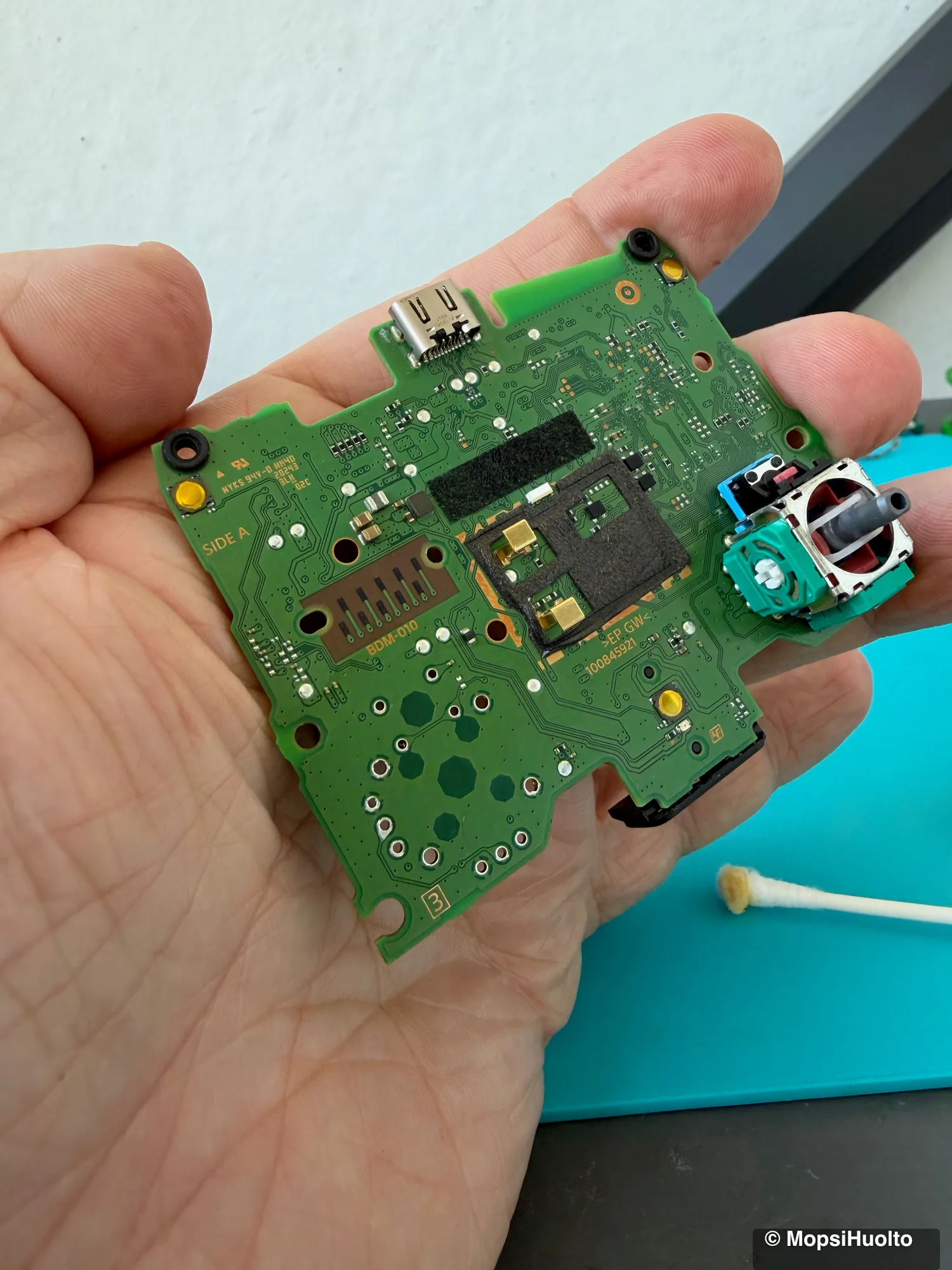
We fit Hall Effect modules, in the DualSense and in both DualShock 4 generations (CUH-ZCT1 and CUH-ZCT2); we don't fit TMR. Every new stick is calibrated before the controller goes back to you. For drift, both types do the same job: they remove the sensor wear. What a Hall module doesn't give you is TMR's stronger signal, better handling of stray fields and lower current draw — if those matter to you, a TMR module is the better part on paper; nobody we found has measured the difference in a controller.
A PS4 controller gets the same work: see DualShock 4 stick replacement, from €30 per stick.
DualSense stick drift in Helsinki: a Hall Effect module soldered in and calibrated, from €30, faults fixed free. Bring it in or post it.
Book a stick replacement →FAQ
Can Hall Effect or TMR sticks still drift?+
Not from sensor wear — the sensor doesn't touch anything. On a TMR stick, iFixit says drift can still come from a tired centring spring, stretched plastic or dirt; for Hall sticks it says "far less prone to drift". Either way, "drift-proof" is too strong.
Is TMR better than Hall Effect?+
On paper, yes. iFixit credits TMR with a stronger signal, tighter dead zones and lower jitter, and with handling stray magnetic fields better; GuliKit's figures put its current draw lower. No one we found has published measurements comparing the two in a controller. Neither type changes the controller's resolution or polling rate, and both remove sensor wear — the cause iFixit calls hardest to avoid.
Do Hall Effect sticks need calibration?+
Yes, in a DualSense or DualShock 4: any new stick, Hall Effect, TMR or stock, is calibrated after fitting, because the calibration is stored on the controller board. A WebHID calibration tool does it over USB in Chrome, Edge or Opera. The DualSense Edge is the exception: its stick modules keep their calibration inside the module, write-protected, and can't be recalibrated by software alone. We still fit Hall Effect sticks into Edge modules and calibrate them before the controller goes back to you.
Do TMR sticks improve battery life?+
A little. GuliKit rates its TMR sensors at 0.1–0.3 mA against 0.5–2 mA for a linear Hall sensor, and iFixit calls the battery gain real but modest. No source we could check puts it in hours of play.
Certified laptop and console repair technician. Twenty years on the bench in Helsinki — tearing down PS5s, MacBooks, and gaming PCs and writing down what we learn.
+358 45 196 9558 →