Every PS4 still in use is old hardware now. The console launched in November 2013 and the last ones were sold years ago, so anything coming in for a clean has the better part of a decade of gaming behind it. That's the first thing to understand about cleaning a PS4: the cleaning intervals that work for a PS5 do not work here. The factory thermal paste is long dried out, the fan blades are long unbalanced by dust, and most consoles that 'suddenly' started roaring have been quietly building up to it for years.
PS4 clean in Helsinki from €79 — dust out, fresh paste, fans quiet again. 90-day warranty.
Book a PS4 clean →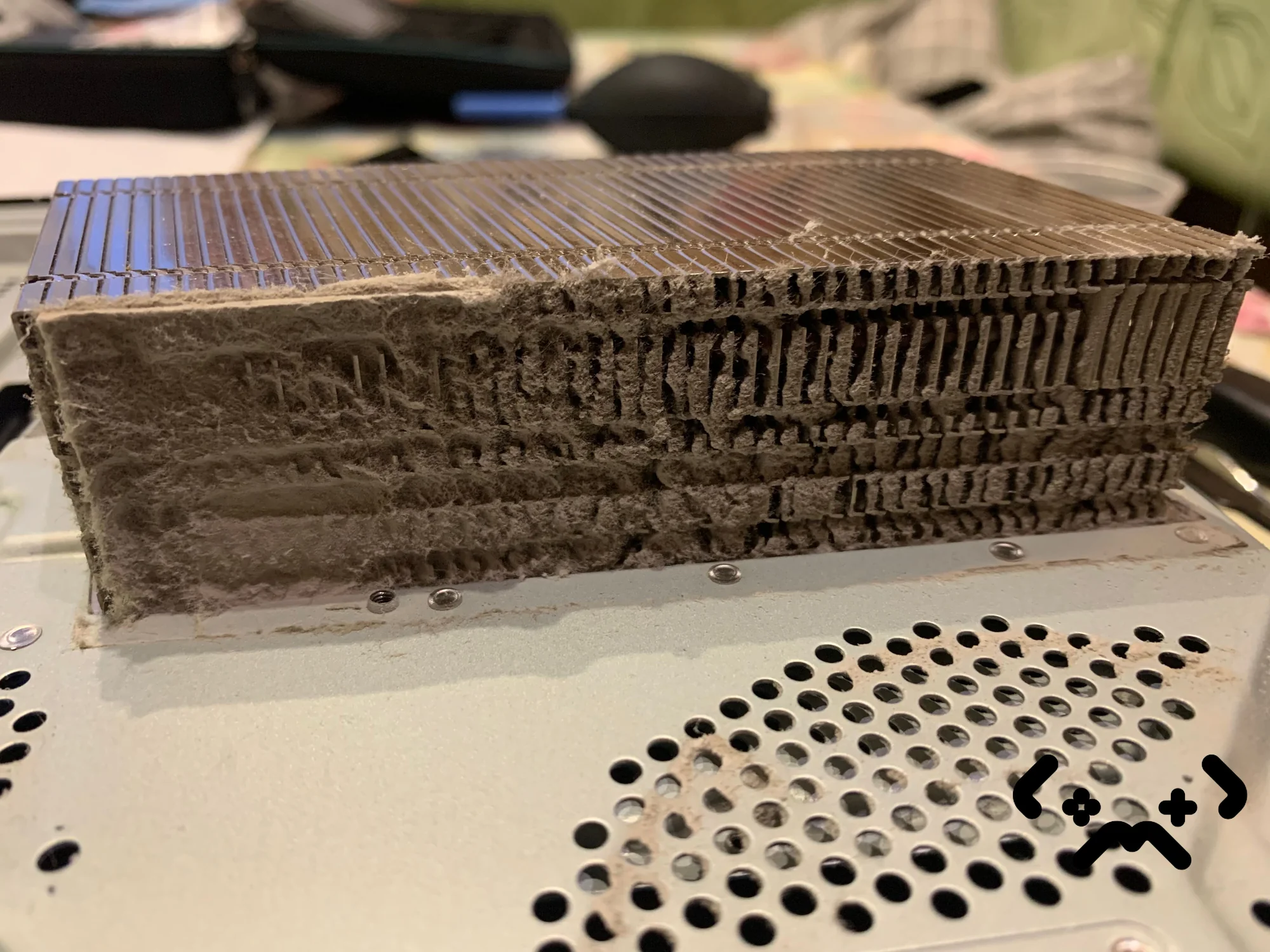
Why a PS4 is a special case
There is no liquid metal under a PS4 heatsink — it ships with regular thermal paste. That is the good news: pulling a PS4 apart for a clean is dramatically simpler than a PS5. The bad news is that factory paste is not forever. On a heavily used console it starts losing contact with the APU die after about four years, and another two or three after that it turns into a grey powder that barely conducts heat at all.
So a PS4 clean is almost never just 'we blew the dust out'. It's 'we opened it, cleaned it, replaced the paste, put it back together'. Anyone selling you a PS4 clean without removing the heatsink is selling you half the job.
The original Fat (CUH-1000/1100/1200) runs the hottest and is the most dust-sensitive — it has a twin fan and a complicated airflow path. The Slim (CUH-2000/2100/2200) is quieter and simpler, but the cleaning interval is the same. The Pro (CUH-7000/7100/7200) looks robust because of its bigger heatsink, and that's exactly why owners delay servicing it — and that's where we end up catching GPU reflow failures.
What builds up inside
A PS4 has a single airflow path: air enters through side slots and exits at the back. Along the way it goes through a mesh, through the blades of a centrifugal fan, and through the heatsink fins. All three are dust traps, and all three clog differently.
- —Intake mesh — first line of defence; the first thing to clog, and much faster in a home with a pet
- —Fan blades — dust settles on the leading edge, alters the aerodynamic profile, and the famous 'jet engine' rumble appears
- —Fan bearing — fine particles work past the seal; the noise becomes constant, RPM no longer drops after the console cools
- —Heatsink fins — the bottleneck for heat removal; this is where airflow drops critically
- —Thermal paste on the APU — dries out at the edges, loses contact, hot spots appear on the die
- —Disc drive — dust on the lens and on the rails, source of grinding sounds and CE-37857-0 read errors
From our teardowns: an average PS4 that hasn't been opened in five years gives up roughly a teaspoon of compacted dust from the heatsink alone. Consoles from homes with long-haired cats — one and a half to two times that. That is not a figure of speech — it is what comes out onto the bench.
What this actually breaks
Below is what actually turns up, in rough order of how often we see it. Only consoles that arrive with a thermal, noise or shutdown complaint — no spills, no drops, no warranty repairs.
| Symptom on arrival, most common first | Root cause |
|---|---|
| 'Jet engine' fan rumble | Dust on blades + aerodynamic imbalance |
| Thermal shutdown mid-game | Dried paste + clogged heatsink |
| Constant roar even in the menu | Worn fan bearing |
| Disc read errors (CE-37857-0) | Dust and grime on the laser lens |
| BLOD / no boot | Heat fatigue led to GPU solder failure |
| HDMI port has drifted | Heat from neighbouring APU degraded the joints |
| Other | Mixed |
The thing the table makes obvious: nearly every thermal complaint on a PS4 comes back to dust and old paste. The BLOD category is especially telling — on a fresh PS4 it's a rare failure, on a ten-year-old console it's the predictable endpoint if it has never been cleaned. Heat stress doesn't kill a console in a day. It slowly wrecks the solder balls under the GPU, and then one evening the machine just doesn't start.
The 'jet engine' effect — what it actually is
The famous PS4 roar isn't a design flaw. It's a fan that has been spun up to nearly maximum because the thermal management chip is reading temperatures over the threshold. On a clean console with fresh paste the fan is audible during God of War but stays steady. On a dusty one with dried paste it sits near maximum for the whole session. Noise grows non-linearly: almost all of the volume comes from the top of the fan's range, which is why a dirty console doesn't sound 'a bit louder' — it sounds like a different machine. If your PS4 sounds like it's trying to take off, that isn't 'just an old console'. That is a specific, fixable state.
“Any PS4 that roars like a vacuum cleaner is a one-evening job on the bench. Any PS4 that has been left to roar for years is a longer, more expensive job.”— Andrei, on the bench
How often to clean
There is no universal answer — but for a PS4 in 2026 the default has shifted. Where 'once a year' is a reasonable starting point for a PS5, for a PS4 that's nearly ten years old the minimum is annual, and in many homes every 8–10 months. Full clean with paste replacement — every 18–24 months mandatory, regardless of how often you've blown out the mesh.
| Environment and load | Surface clean (mesh) | Full clean + paste |
|---|---|---|
| Clean flat, no pets, 1–2 hr/day | Every 12 months | Every 24 months |
| Average flat, 3–4 hr/day | Every 8–10 months | Every 18 months |
| Pet in the home / carpet / 4+ hr/day | Every 6 months | Every 12 months |
| Smoker household | Every 4–6 months | Every 9–12 months |
| PS4 Pro in a closed cabinet | Every 6–8 months | Every 12–15 months |
If the fan is audibly loud in the menu (not in a game — in the menu!), you're past the line. If the console shuts down during a long session, you're well past it and every further thermal cycle is shortening the GPU's life. If the PS4 'has started lagging', that isn't disc wear, it's the thermal management throttling the APU because it's hot.
There is a flip side. A PS4 that sits unused and runs once a fortnight does not need frequent cleans. The driving factor isn't calendar age, it's hours under load plus dust in the room. A machine that's actually been played for four hours a day for eight years has covered a thermal mileage Sony never designed it for.
What a proper clean looks like
A surface clean on a PS4 is removing the top cover and blowing the heatsink and fan with compressed air. On a console under four years old that's a useful interim measure. On a console older than five it's half the job, because the paste is no longer the paste it was.
- —Remove the top cover (single Phillips for a Slim, T8/T9 security for Fat and Pro)
- —Remove the PSU and motherboard — yes, on a PS4 you cannot reach the heatsink properly without a full strip-down
- —Unscrew the heatsink (four spring-loaded screws, diagonal pattern)
- —Remove old paste from the APU and the heatsink base with 99% IPA on a lint-free cloth
- —Vacuum the heatsink fins from the exhaust side with a soft brush — never blow into the fins, that drives the dust deeper
- —Pull the fan apart, clean the blades and shroud, check the bearing for play and rumble
- —Apply fresh medium-viscosity paste (MX-4, Kryonaut, NT-H2) in a thin even layer — no 'dots in the corners'
- —Reassemble with correct heatsink screw torque, in three diagonal passes
- —Run a stress game for 30+ minutes, log exhaust temperature and fan RPM
Total bench time for us: about 60 minutes for a Slim, 75–90 for a Fat, 90–120 for a Pro. If we find a drifting HDMI port or early GPU detachment along the way, that becomes a separate repair — and it's worth doing in the same session because the console is already open.
DIY or bring it in
A PS4 is noticeably easier to take apart than a PS5. If you have T8/T9 drivers, decent paste, a clean workspace, and an hour, this is a viable home job. Three places where first-timers come unstuck: the Blu-ray drive power ribbon (easy to tear on a Slim), the six thin screws under stickers on a Fat (easy to strip the heads under those stickers), and the heatsink screw torque pattern (tighten one side first and you'll lose contact with the die — making the heat worse than before the clean).
Three reasons not to do it yourself: you've never opened consumer electronics, you don't have proper paste or you only have a 'universal' tube from AliExpress (worse than factory), or your PS4 already shuts down under load — because at that point paste may have migrated and a clean alone won't fix it. Our full PS4 clean with paste replacement is €89, parts and labour included, 90-day warranty.
FAQ
Can a PS4 be cleaned without opening it?+
Technically yes — blow the mesh and the slots from the outside with compressed air. On a console under three years old that buys you a couple of months of quiet. On a six-to-eight-year-old PS4 it's almost useless: the bulk of the dust is already inside the heatsink fins and on the fan blades, and you can't reach it from outside. And the paste under the heatsink is dried out anyway.
Vacuum or compressed air can?+
From the outside — vacuum on the lowest setting through a brush nozzle. A compressed-air can at full pressure drives dust deeper into the heatsink and onto the board. Inside (once the console is open) — soft brush plus vacuum from the exhaust side of the heatsink. Never blow compressed air into a stationary fan without holding it still — it can spin past its rated RPM and finish off whatever balance it had left.
Which thermal paste should I use on a PS4?+
A medium-viscosity high-performance paste: Arctic MX-4, Thermal Grizzly Kryonaut, Noctua NT-H2. Liquid metal is not needed and not recommended — the PS4 APU has an integrated heat spreader (not a bare die), so the difference between good paste and liquid metal is negligible here, and the spill-and-short risk is high.
How long will a PS4 last with regular cleaning?+
We have ten and eleven-year-old PS4s on the bench that are still healthy because they were serviced regularly. For consumer electronics in this class that is a very good run. The thing that kills a PS4 in the long term isn't component lifespan, it's accumulated thermal stress. A clean console with live paste can outlive another generation.
Will the warranty be voided?+
Any PS4 older than two years is out of Sony warranty already. In Finland, breaking the seal on a post-warranty console legally costs you nothing. If your PS4 is somehow still under an extended retailer warranty, take it to the authorised service — the clean will be free.
PS4 roars but doesn't shut down. Can I leave it?+
You can, but it's a bad strategy. Every month it spends 'in the roar' is a month of accelerated bearing wear and a month of thermal stress on the GPU solder balls. A fan replacement costs more than a clean. A GPU reflow costs more than a fan replacement. The cheapest stage to fix is the very first one.
Certified laptop and console repair master. Twenty years on the bench in Helsinki — tearing down PS5s, MacBooks, and gaming PCs and writing down what we learn.
+358 45 196 9558 →