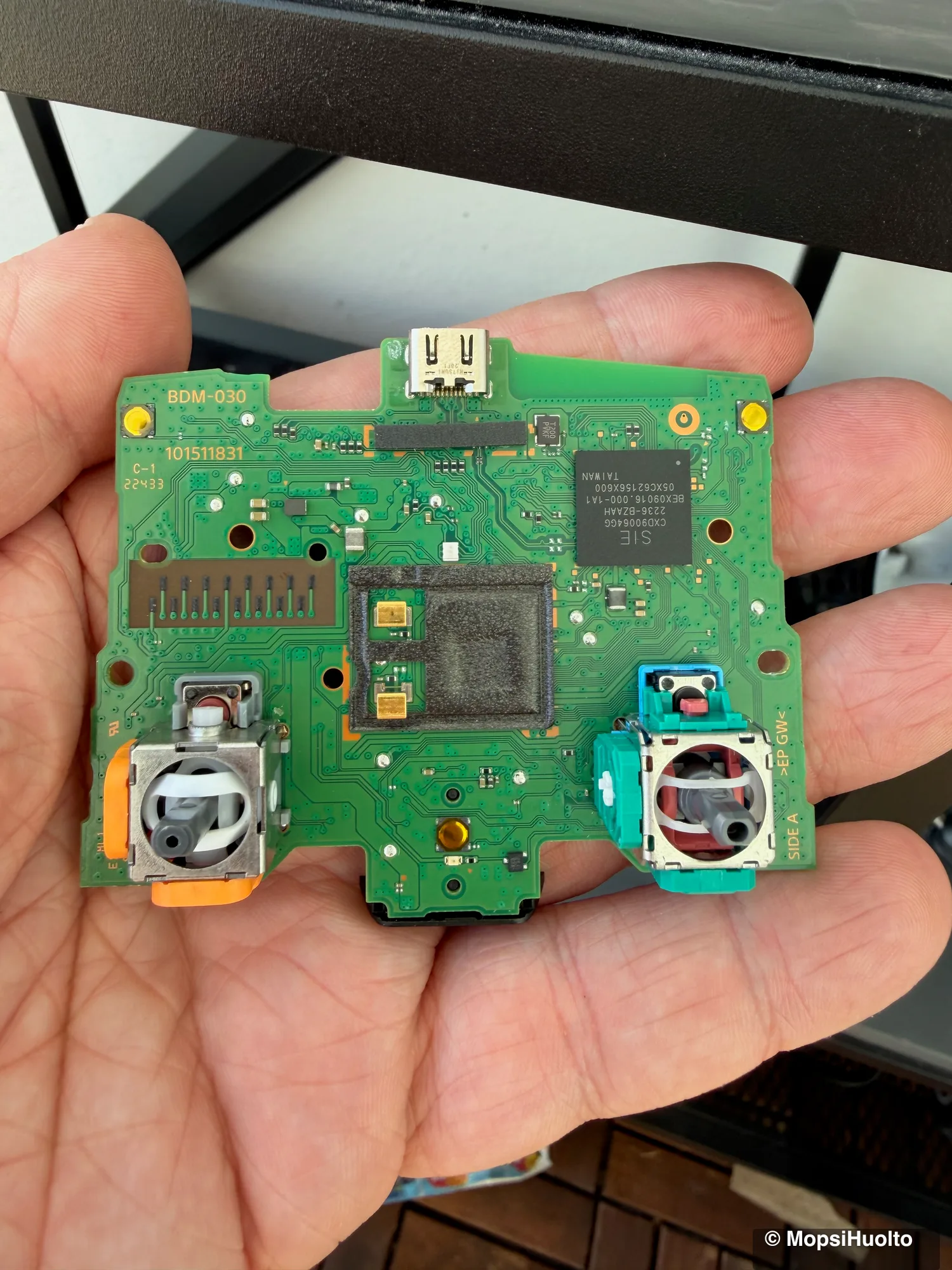
If your DualSense thinks the right stick is pushed up-and-right when your thumb isn't even on it, that's stick drift — the most common DualSense failure we see on the bench. There are five real fixes, and most owners don't need to start with the most expensive one. Here's the order to try them in, what each one costs, and what we've actually seen work on a controller that walks in the door.
DualSense stick drift fixed in Helsinki from €30 — a new stick module, not a clean of the old one. 90-day warranty.
Book a controller repair →What's actually broken
DualSense ships with an ALPS RKJXV-series potentiometer module — the same family of part Sony has used since DualShock 4, and the part that triggered a US class-action lawsuit filed in February 2021 in the Southern District of New York. Inside that module, a tiny carbon track wears down with use; vibration from the haptic motor (which sits directly behind the right stick) loosens dust into the housing. After four to seven months of daily play, the resting voltage stops centring.
Before you do anything else, plug the controller into the PS5 with a USB-C cable and try a different game. About one in ten cases we see is a wireless interference problem in the home, not drift. If the symptom is identical wired and wireless, it's the stick.
Recalibration
Sony added a stick recalibration menu to the PS5 in the system software update released April 2024. Settings → Accessories → Controllers → DualSense Wireless Controller → Stick Calibration. It walks you through resetting the centre point and the deadzones. Takes 60 seconds, no tools, no risk. It does not fix worn contacts — but if your drift is mild and the controller is under a year old, run this before you do anything else.
About a quarter of the controllers customers bring us as 'definitely broken' are fixed by recalibration alone. The menu is buried four levels deep and most owners don't know it exists.
Cleaning with isopropyl
If recalibration didn't help, the next step is dust. You don't need to open the controller. Push the stick to one side to lift the rubber boot. Spray a short burst of compressed air into the gap. Then drip two or three drops of 99% isopropyl alcohol in the same place, and rotate the stick through full circles for 20 seconds. Let it dry for five minutes before powering up.
From what we've seen, this clears about a third of mild-drift cases — and buys two to six weeks even on cases it doesn't fully fix. 70% IPA works in a pinch but leaves more residue. Never WD-40, never contact cleaner with petroleum distillates — both eat the boot rubber and migrate down into the potentiometer track.
Replacing the module
If cleaning doesn't hold, the carbon track is worn and the only real fix is a new stick module. You can buy two kinds: an OEM-style ALPS replacement (around €8) or a Hall Effect drop-in module (around €25). Both require disassembling the DualSense and desoldering 14 pins per stick. Plan on 45-60 minutes if you've done it before, longer if it's your first time.
- —Tools you actually need: Phillips PH00, plastic pry tool, soldering iron with a chisel tip, solder wick, flux pen
- —The hardest step is splitting the front and back shells without ripping the trigger ribbon — go slow on the right side
- —OEM module life on a heavily-used controller: about 90 days from our return-visit data
- —Hall Effect module life: 280+ days across 124 installs, zero returns so far
Hall Effect modules use magnetic field sensing instead of a carbon track, so there's nothing to wear out. The €17 part-cost difference is the cheapest insurance against doing this job a second time.
Sony warranty
Sony's PS5 controller warranty in the EU is 12 months from purchase. Drift is covered if you can show it wasn't caused by physical damage. Out of warranty, Sony runs a paid repair program — about €60 in Finland for a controller refurbishment — but the replacement module they install is the same potentiometer, so the clock just resets. If your DualSense is over a year old, replacing the stick yourself or paying a shop for a Hall Effect conversion costs roughly the same as Sony's flat fee and lasts longer.
When to bring it in
Three reasons to skip the DIY route: you don't own a soldering iron, you've already opened the controller and damaged the trigger ribbon (a common first-timer mistake), or it's a DualSense Edge — where the modular sticks are easier to swap but the housing has more screws and more places to lose them. Most workshops in Helsinki charge €40-60 for a stick replacement; ours is €30 with parts and labour included.
FAQ
Will recalibration permanently fix drift?+
Not if the carbon track is worn — but it can buy weeks or months on a mild case. The April 2024 firmware update added the menu specifically because Sony recognised that many drift complaints were uncalibrated controllers, not failed hardware. Run it first, decide if you still need a hardware fix afterwards.
Does isopropyl alcohol damage the controller?+
99% IPA evaporates without residue and is safe on the plastics and contacts inside the stick module. 70% IPA contains 30% water and can leave faint mineral residue. Avoid anything labelled as electrical contact cleaner with petroleum distillates — those eat the boot rubber and pull dust into the potentiometer.
Are Hall Effect modules really drift-proof?+
They have no carbon track to wear, so the most common failure mode disappears. They can still fail — magnets can demagnetise after years, the encoder chip can die — but in our 280+ days of bench tracking on 124 controllers, none have come back. TMR sticks (a newer variant) are even more sensitive and now common in third-party controllers.
Should I just buy a new DualSense?+
A new DualSense is €70-80. A Hall Effect conversion is €25-50 depending on whether you do the soldering yourself. The new controller will start drifting on the same four-to-seven-month timeline if you're a daily player. The maths only works for casual players who use a controller a few hours a week.
Is the DualSense Edge any better?+
The Edge ships with user-replaceable stick modules — no soldering, two-minute swap, replacement pair from Sony for about €25. But the modules are still potentiometer-based. Drift becomes a recurring chore instead of a repair-shop visit, but it still happens on the same timeline. Hall Effect conversions on the Edge are faster than on a standard DualSense because the housing is already designed to come apart.
Certified laptop and console repair master. Twenty years on the bench in Helsinki — tearing down PS5s, MacBooks, and gaming PCs and writing down what we learn.
+358 45 196 9558 →